
The quickest cash option isn’t always the one that brings the most peace of mind. When a bill is due before payday and savings are limited, focus on covering the actual shortfall without making next month harder. That’s the goal of finding peace of mind emergency cash.
It’s understandable to feel pressure to act fast. Before borrowing, confirm the bill and due date, check whether the biller can offer more time or split the payment, and work out how much you can use from savings without putting another essential expense at risk. If you consider a loan, compare its full cost and payment dates with your budget.
This guide covers practical ways to handle a shortfall, key loan terms, and credit-check considerations. If borrowing is worth considering, QuickCashDirect is a free online loan-introduction service, not a lender. It connects applicants with lenders offering personal loans of $300-$3,000 for qualified consumers. Checking rates uses a soft credit check and doesn’t affect your score. Approval depends on lender criteria, so compare your options before deciding what to do next.
Key Takeaways
- Confirm the bill, due date, and exact shortfall before choosing a cash option.
- Compare savings, bill extensions, employer advances, community assistance, and borrowing by access time, repayment, cost, and effect on your future budget.
- For a loan, review the APR, term, payment schedule, total repayment, and any lender-specific fees together.
- Borrow only what you need, and only if the scheduled payments fit your budget.
- QuickCashDirect connects applicants with lenders offering $300-$3,000 loans, 3-36-month terms, and 5.99%-35.99% APR for qualified consumers. Lenders make approval decisions.
Peace of mind emergency cash starts with a clear view of the shortfall
An unexpected bill can make every choice feel urgent. Pause long enough to confirm the amount, deadline, and resources available to you. Emergency cash can mean money you can use, or another practical solution, to cover an urgent expense. It doesn’t automatically mean taking out a loan. A clear picture of the bill and your upcoming income can help you choose a response without turning a shortfall into a longer-term strain.
Keep today’s cash gap separate from building savings for future surprises. An emergency fund is money set aside for unexpected expenses. The linked external content is provided for reference; QuickCashDirect isn’t responsible for it, and you use external content at your own risk. Savings can help prepare for a later expense, but you don’t need to meet a savings target before dealing with an urgent bill.
Is the expense urgent, essential, and unavoidable?
Start with three details: the exact amount owed, the due date, and what may happen if you pay late. Check the bill or account directly for adjustments, payments already made, and extension options. The amount you first have in mind may not be the amount you actually need.
Then sort the expense by urgency. Housing, utilities, necessary transportation, and essential medical needs may need prompt attention. A nonessential purchase, upgrade, or service may be postponed, reduced, or canceled. Consider the consequences of delay: a bill with a serious late-payment consequence needs a different response from one that can safely wait. This check keeps your attention on the real shortfall, not every expense competing for it.
Emergency savings and emergency borrowing serve different roles
Savings can cover a surprise without adding a new payment to your budget. If you have funds available, consider whether using some would leave enough for other near-term essentials. If savings are limited or unavailable, you can still assess options such as asking for a payment extension or comparing borrowing terms. Each choice affects your future cash flow differently.
The right response depends on how soon the expense is due, what resources you can use, and whether you can manage any repayment. That’s the foundation of peace of mind emergency cash: match the solution to the shortfall, not just the pressure of the moment. A loan may help address an urgent need, but only if its payment schedule fits alongside your regular bills. If repayment would leave you short for another essential payment or require you to borrow again, pause and compare alternatives. Once the immediate issue is handled, you can consider a savings plan for future emergencies at a pace that fits your finances.
Compare emergency cash options by speed, repayment, and financial impact
Once you know the size of the shortfall, compare options by more than how quickly money may be available. Ask what you’ll owe, whether repayment is required, and how the choice affects your next paycheck and upcoming bills. A payment arrangement or assistance program may cover part of the need, leaving less to borrow or nothing to borrow at all.
Use the table as a starting point. Timing and terms vary by biller, employer, program, and lender, so these are general comparisons, not guarantees.
| Option | Access time | Repayment and possible cost | Future cash-flow effect |
|---|---|---|---|
| Existing savings | Potentially immediate | No loan repayment; using savings may reduce your reserve | Less cash available for later needs |
| Bill extension or payment arrangement | Depends on the biller’s response | May shift a due date or divide payments; terms and any charges vary | Moves or spreads an expense across future periods |
| Employer advance | Depends on employer policy | May need to be repaid through a future paycheck; terms vary | Could leave less take-home pay later |
| Community assistance | Depends on program timing and eligibility | Support may not require repayment, but program terms vary | Could reduce the amount you need to cover yourself |
| Borrowing | Depends on the lender’s process and decision | Repayment, APR, and any lender-specific fees depend on the offer | Scheduled payments reduce future income available for other bills |
Check non-loan options before taking on repayment
Contact the biller and ask whether you can change the due date, split the payment, or arrange more time. Write down the conditions and confirm the revised amount due. You can also look into employer advances or community assistance, keeping in mind that eligibility and timing vary. Compare the consequences of paying late with the cost and repayment commitment of borrowing. Federal Reserve research explores financial literacy and emergency savings. QuickCashDirect isn’t responsible for external content; use it at your own risk.
When borrowing may be worth evaluating
Borrowing may be worth considering if the expense is urgent, other options don’t resolve the gap, and the payments appear manageable alongside your regular bills. Review the APR, loan term, scheduled payment, total repayment, and any lender-specific fees together. A lower payment can come with a longer repayment period, so look beyond the amount due each time. For context on short-term borrowing, the payday loan guide explains key considerations, while the cash advance guide covers that option separately. If borrowing still seems suitable, compare online loan options as one possible next step.
Assess an emergency loan offer without adding avoidable stress
A fast decision can still be a careful one. Before accepting an emergency loan, read the full offer and confirm how much you’ll receive, how much you’ll repay, and when each payment is due. Compare the terms with your actual budget, not just the advertised payment or rate. A clear review can help you decide whether borrowing supports peace of mind emergency cash or adds pressure later.
Use this checklist before you accept:
- Amount: Is it limited to the shortfall you need to cover?
- APR: What annual percentage rate applies to this specific offer?
- Term: How long will repayment take?
- Payment schedule: What are the payment amounts and due dates?
- Total repayment: What will you pay altogether over the full term?
- Fees: Does the lender agreement disclose any lender-specific fees?
An advertised rate range isn’t a personal offer. QuickCashDirect connects applicants with lenders offering 5.99%-35.99% APR for qualified consumers. The rate and other terms depend on lender criteria, including income and ability to repay. Review the offer made to you rather than assuming you’ll qualify for the lowest rate.
For illustration, a representative example is a $1,000 loan over 12 months, with $1,134.72 total payback and 29.82% APR. The total repayment shows the full cost in that example. Your own offer may have different terms, so check its disclosures before deciding.
Can the monthly payment fit your actual budget?
Set the proposed payment beside your take-home income, essential bills, and existing debt obligations. Check the due date, too. A payment that looks manageable on paper may be difficult if it falls before income arrives or alongside other major expenses. If it leaves no room for ordinary needs or unexpected costs, consider whether a lower loan amount or a non-loan option could address the shortfall. Don’t rely on approval or a future change in income to make the plan work.
Understand credit checks, fees, and repayment terms
Checking rates through QuickCashDirect uses a soft credit check and doesn’t affect your credit score. A hard inquiry may occur only if you accept an offer. QuickCashDirect is a free online loan-introduction service, not a lender, and doesn’t make lending decisions. Any lender-specific fees are disclosed in the loan agreement.
Most lenders allow early payoff without penalty, but review your specific agreement for the terms that apply. Before accepting, confirm that the payment dates, total repayment, and any fees match your understanding. A loan is worth considering only when the repayment plan fits your budget.
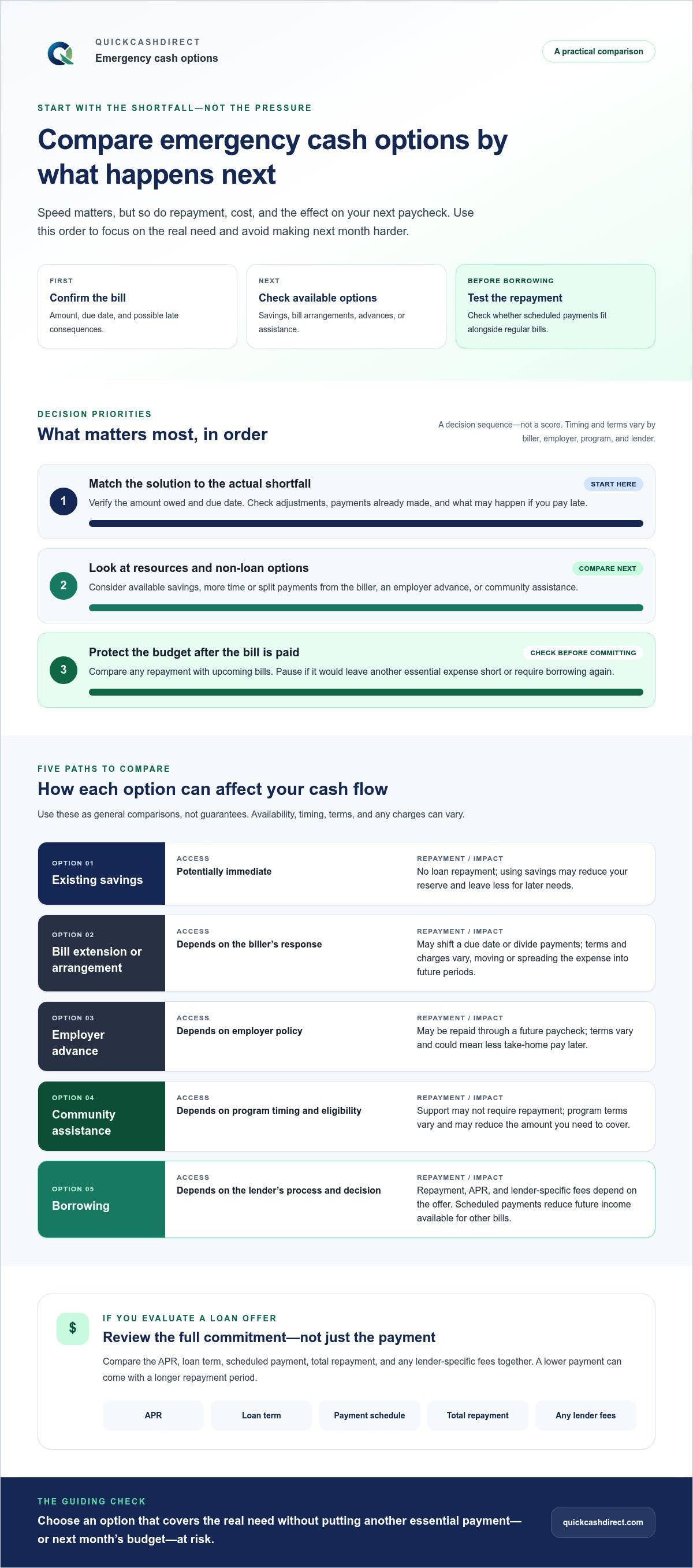
Use a practical decision sequence before seeking emergency cash
A clear sequence can make the search for peace of mind emergency cash more manageable. Work through these steps before committing to a source of funds, keeping the bill, due date, and next budget cycle in view.
- Confirm the bill. Check the balance, deadline, and any payment arrangement already available. Use the verified amount, not an estimate.
- Calculate the gap. Subtract funds you can use without putting another essential expense at risk. This gives you a realistic target.
- Check alternatives. Consider savings, a bill extension, employer assistance, or community programs. Another option may reduce the amount you need to borrow.
- Compare terms. Review APR, payment dates, term, total repayment, and lender-specific fees. Map each payment against your existing obligations.
- Decide based on fit. Borrow only what you need, and only if the repayment schedule fits your budget. If it doesn’t, pause and reconsider alternatives.
Comparing total repayment and payment timing helps show whether peace of mind emergency cash is manageable. A payment may look affordable on its own but strain your budget if it lands before income arrives or overlaps with another essential bill.
Build a short-term plan around the bill’s due date
Separate the urgent deadline from other upcoming expenses. Record the amount due, the payment deadline, and when you expect income. Then map any proposed loan payments against housing, utilities, food, transportation, and existing obligations. If you accept a loan, note each payment date and set a reminder. This can help you spot a tight week before it arrives.
Rebuild a cash buffer after the emergency passes
Once the immediate expense is handled, decide what your next budget cycle can realistically support. A small, repeatable savings contribution can build a future buffer without putting current bills at risk. Accessible savings may help with later surprises, but they can’t guarantee that every emergency will be covered.
If you’re comparing borrowing options and have credit concerns, the bad credit loans guide offers broader context. Keep peace of mind emergency cash in view as you weigh any offer. Review loan options through QuickCashDirect and consider an offer only if its repayment schedule fits your budget.
How QuickCashDirect can connect eligible applicants with emergency cash options
After comparing savings, payment arrangements, and other alternatives, an online loan-introduction service may be one route to consider. QuickCashDirect is free to use and isn’t a lender. It connects applicants with lenders offering personal loans of $300-$3,000, with terms of 3-36 months and APRs of 5.99%-35.99% for qualified consumers. Lenders review applications and decide whether to make an offer. Approval depends on lender criteria, including income and ability to repay.
The online process has three steps, and the online approval process takes under five minutes. This timing isn’t a promise of approval or funding. If a lender approves an application, funds may be deposited directly into your bank account in as little as 15 minutes. Funding timing depends on the lender and approval, and most lenders provide same-day or next-business-day funding after approval.
What happens after an online application?
Complete the online application, review any lender offer you receive, then decide whether to accept it. Check the payment schedule, APR, total repayment, and lender-specific fees before agreeing. QuickCashDirect uses bank-level encryption, and applicant information is shared only with lenders selected through the process. If you accept an offer, the lender’s agreement sets out the terms, including repayment. Funds are sent by direct deposit, with timing dependent on approval and the lender.
Keep the decision informed and the disclosures clear
All credit scores are welcome, but that doesn’t mean every applicant will be approved. Lenders assess each application, including the applicant’s ability to repay. Check the offer against your budget and don’t treat a rate range as a personal quote. Checking rates uses a soft check and doesn’t affect your credit score. A hard inquiry may occur only if you accept an offer.
Most lenders allow early payoff without penalty, but review your specific loan agreement for the terms that apply. Any lender-specific fees are disclosed in the lender agreement.
Before using the site, review its terms. Disputes are resolved individually through arbitration, and class-action arbitration is waived. The site is provided as is, without warranties about accuracy, completeness, or correctness. To the extent permitted by law, liability is limited to any amount paid for site access. Implied-warranty exclusions may be restricted by local law, so check the laws that apply where you live.
If an offer fits your immediate need and repayment budget, explore emergency loan options and review the available terms before deciding.
Choose a next step that supports your budget
Make the next step deliberate, not rushed. Set a clear limit for what you need, decide what repayment you could manage, and don’t accept an offer that would leave essential expenses uncovered. Peace of mind emergency cash isn’t only about addressing a bill today. It’s also about protecting room in your budget for what comes next.
If borrowing remains a fit after comparing alternatives, QuickCashDirect offers a free loan-introduction service, not lending decisions. You can apply online from a mobile device, and checking rates uses a soft check that doesn’t affect your credit score. Any loan offer, approval, and terms depend on the lender and your qualifications, so read the agreement before deciding.
Take the time you need to make an informed choice. Explore emergency loan options and review any offer against your needs and repayment capacity.
Frequently Asked Questions
How much emergency cash should I keep for peace of mind?
There isn’t one reserve amount that fits every household. Base yours on essential expenses, income stability, and the needs of anyone who depends on you. Choose a contribution you can repeat, even if it starts small, rather than stretching your budget to reach an arbitrary target. Keep the money accessible for genuine surprises. If a bill is due now, focus first on the immediate shortfall and the options available today.
Can I get emergency cash without taking out a loan?
Possibly. Ask whether the biller can move the due date or divide the balance into payments. You might also have access to employer assistance, community programs, or savings you can use without missing another essential expense. Availability and timing vary, so confirm an option can meet the deadline before relying on it. Weigh the consequences of paying late against the repayment commitment of borrowing.
Does checking emergency loan rates affect my credit score?
Checking rates through QuickCashDirect doesn’t affect your credit score because the rate check uses a soft inquiry. A hard inquiry may occur only if you accept an offer. Read the lender’s inquiry disclosure and agreement so you know what accepting means. A rate check helps you compare a possible offer, but it doesn’t promise that a lender will approve an application or provide funds.
How quickly can emergency loan funds arrive?
Timing varies by lender, approval, and bank processing. QuickCashDirect says funds may arrive by direct deposit in as little as 15 minutes, and most lenders provide funding the same day or next business day after approval. Treat those timeframes as possibilities, not a deadline you can rely on. If the bill has a firm due date, consider what happens if funds arrive later.
Is approval for emergency cash guaranteed with bad credit?
No. QuickCashDirect welcomes applicants across credit scores, but a lender decides whether to make an offer. Lenders assess factors that include income and ability to repay, so an application may not result in funds. Before applying, work out how a possible payment would fit around essentials and existing obligations. If repayment would leave too little for regular expenses, revisit other ways to manage the bill.
Can I repay an emergency loan early without a penalty?
Most lenders allow early payoff without a penalty, but the terms in your own loan agreement control. Before accepting, look for instructions on requesting a payoff amount and how payments are applied. If you decide to pay early, use the lender’s current payoff figure rather than estimating from the scheduled installments. Keep confirmation of the payment and any remaining balance for your records.
Can I apply for emergency cash from my phone?
Yes. QuickCashDirect’s online application is mobile-compatible, so you can use a phone or another device without visiting a physical store. Before submitting, review your entries for errors and make sure you can read the lender’s offer and agreement clearly. Check the payment dates and terms before accepting. Applying from a phone doesn’t guarantee approval, a particular APR, or when funds may arrive.