
A quick-approval promise isn’t a reliable way to choose loans for hard to approve applicants. Lenders can’t guarantee approval before reviewing an application. Compare the terms and process, not just the advertised speed.
It’s understandable to focus on whether you’ll qualify, especially when you need money urgently. But the cost, repayment schedule, lender policies, and application requirements matter just as much as the decision itself.
This guide explains how to compare loan costs, funding speed, application requirements, and the information lenders may request. You’ll also see how personal loans, installment options, and short-term advances differ, helping you weigh the trade-offs. Focus on the total repayment and whether the schedule fits your budget. Then choose an option that matches your needs rather than relying on an approval promise.
Key Takeaways
- Compare the APR, fees, repayment schedule, and total amount repayable, not just the advertised monthly payment.
- Match the loan type and repayment term to the amount you need and the payment your budget can manage.
- Review funding timelines and application requirements so you can prepare the right information and avoid delays.
- Check lender policies, eligibility criteria, and application support before choosing a borrowing option.
How should I choose a bad-credit personal loan?
Compare loans for hard to approve applicants by cost, repayment schedule, eligibility rules, and lender policies. Focus on the full repayment obligation, not approval language alone.
Loan Amounts, APRs, and Repayment Terms
Request only what you need. Compare APR, origination fees, payment frequency, term, and total repayment. A lower monthly payment can cost more overall if the term is longer. Personal and installment loans use scheduled payments, while short-term advances have a shorter repayment window. Compare offers for the same amount and term to see the differences clearly.
| Option | Repayment pattern | Compare |
|---|---|---|
| Personal loan | Fixed schedule | APR and total repayment |
| Installment loan | Scheduled payments | Term and payment fit |
| Short-term advance | Shorter repayment window | Due date and full cost |
Choose the option with payments your budget can support.
Eligibility and Application Requirements
FICO scores below 580 generally indicate bad credit; VantageScore considers scores under 600 bad credit. Banks, credit unions, and online lenders offer personal loans, each with its own eligibility criteria. Prepare identification, income details, housing costs, and bank account information. State laws and loan limits vary by location and loan type, so compare applicable terms before accepting an offer.
For loans for hard to approve applicants, accurate application details help lenders assess eligibility and ability to repay.
Cosigners and Approval Chances
A cosigner with stronger credit may support an application, but takes on equal responsibility for repaying the debt. If the primary borrower defaults, the cosigner assumes legal liability. Discuss the payment plan and missed-payment risks before applying together. A cosigner does not replace review of income, existing debt, and application details, and approval still depends on the lender’s assessment.
Guaranteed-Approval Warning Signs
No lender can guarantee approval before reviewing an application. Treat guaranteed-approval claims as a warning sign, especially if an offer hides repayment terms or pressures you to act. Payday and title loans can be costly. With a title loan, pledged collateral may be taken if you fail to repay. You can make your application more accurate by requesting a realistic amount, reporting truthful income, and reviewing your outstanding debt before applying. Compare loans for hard to approve applicants with these risks in mind.
Funding speed and application support
Approval and fund delivery are separate stages. Compare both timelines, then prepare your application to reduce avoidable delays.
Application and Funding Timelines
Personal loan approval can take from a few minutes to 10 days, depending on the lender and applicant’s circumstances. That estimate covers approval, not the time required to receive funds. Ask how each stage works: application review, decision, agreement, and deposit. A fast decision won’t help if fund delivery misses the date you need.
For a fair comparison, check whether the lender gives an estimated decision time or funding time. Then consider what could affect the schedule, such as incomplete income details or a bank account that needs verification. Applicants with limited credit histories may face additional review. Keep your phone and email accessible so you can respond promptly to requests.
Application Process and Support
Before applying, gather identification, income information, bank account details, and housing costs. Enter each item consistently. Mismatched application and supporting details can slow the review. Follow the lender’s instructions for submitting documents and completing identity checks. A clear process should explain what happens after submission and how the lender communicates its decision.
Compare the support offered during application, not just the speed of the online form. Look for clear instructions, a way to resolve technical problems, and an explanation of next steps. These details affect how easily you can complete the process, especially if a lender requests more information. Don’t submit multiple applications without considering their credit-check policies. If you’re considering a loan with bad-credit options, review the application terms and repayment details before proceeding.
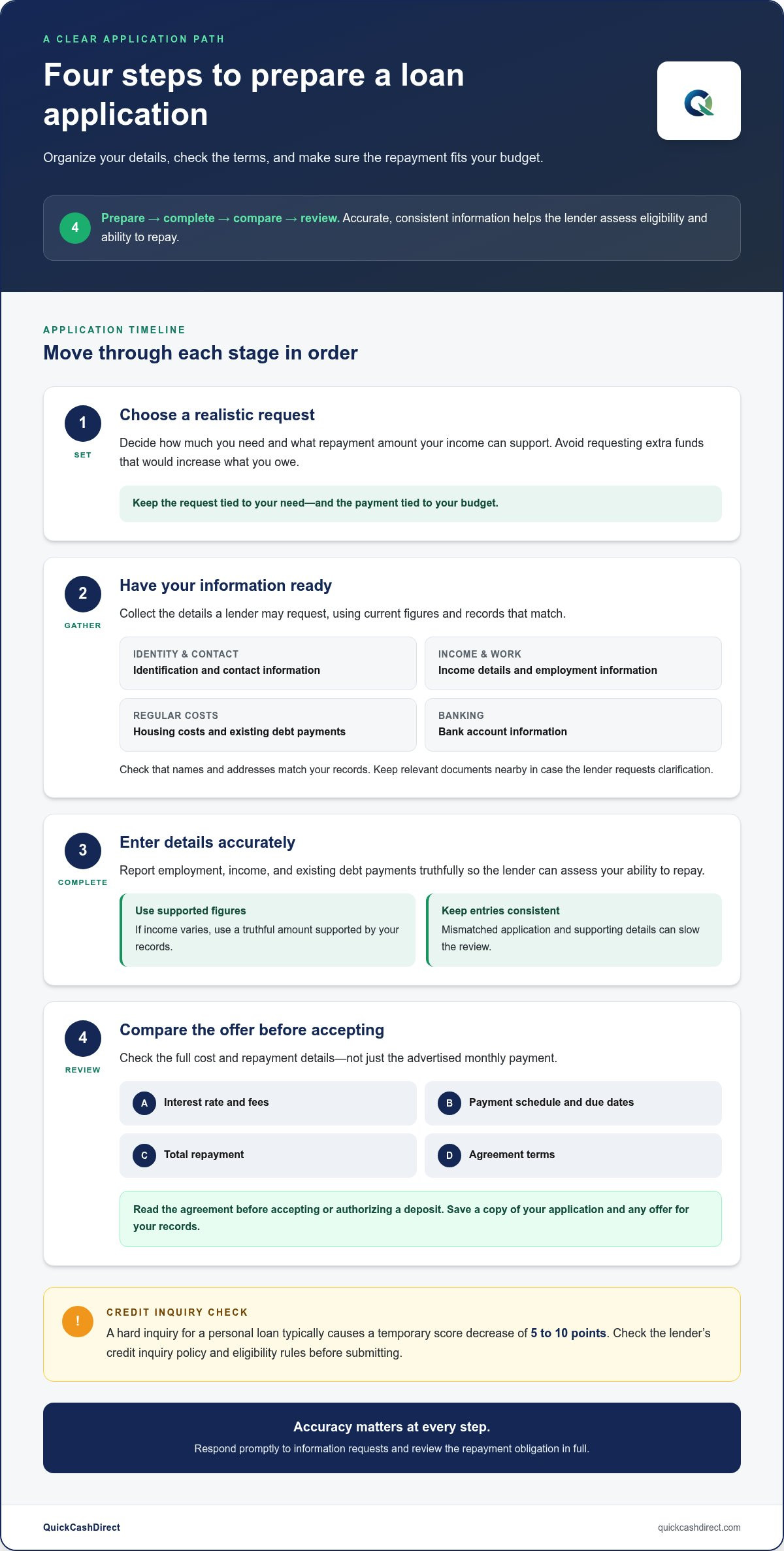
Application steps and required information
Prepare your details before applying. A complete, consistent application helps the lender assess whether you qualify and what terms it may offer.
- Set the request. Choose the amount you need and a repayment amount your income can support. Avoid requesting extra funds that increase the amount you’ll owe.
- Gather details. Have identification, contact information, income details, housing costs, and bank account information ready. Use current figures and check that names and addresses match your records.
- Complete the application. Enter your employment and income accurately. Include existing debt payments so the lender can assess your ability to repay, even with bad credit.
- Review the offer. Compare the interest rate, fees, payment schedule, total repayment, and due dates. Read the agreement before accepting or authorizing a deposit.
Accuracy matters. If your income varies, for example, provide a truthful figure supported by your records rather than overstating what you can afford. Keep relevant documents nearby in case the lender asks for clarification. Respond promptly to requests, and save a copy of your application and any offer for your records.
Check the credit inquiry policy before submitting. A hard inquiry for a personal loan typically causes a temporary score decrease of five to 10 points. This can affect your credit score, so avoid sending applications without first reviewing eligibility rules and the lender’s process. A pre-qualification review, where available, may help you assess possible terms before a full application.
Consider whether the loan is secured. With a secured loan, you pledge collateral against repayment. The lender may have the legal right to take possession of it if you fail to repay. Before accepting, make sure the interest rate and payment dates fit your budget, and understand the consequences of missed payments. Don’t focus only on approval. Choose an offer you can manage while paying your other bills.
Comparing APRs, fees, payments, and lender policies
Compare the written offer, not just the advertised rate. Review APR, fees, monthly payments, and lender rules side by side.
Comparing APRs and Fees
APR helps compare borrowing costs because it reflects the interest rate and certain fees. Check the origination fee, other charges, and whether fees reduce the amount you receive. Compare offers using the same loan amount and repayment term. Otherwise, a smaller payment may simply reflect a longer repayment period.
Compare the total amount repaid alongside each monthly payment. Confirm whether a fee is deducted upfront or added to the balance. Read the agreement for late-payment charges and other conditions. Include any credit card payment when assessing affordability, since it affects the cash you have available each month.
Comparing Lender Policies
Lender policies differ on minimum credit scores, income review, credit checks, and repayment flexibility. The U.S. Environmental Protection Agency notes that lenders can modify or remove credit-check requirements to expand access for low- and moderate-income borrowers. This may affect how a lender evaluates credit history, but it doesn’t remove the need to assess ability to repay.
Read each lender’s eligibility criteria, prequalification process, payment schedule, and penalty terms. Check whether applying triggers a hard inquiry, and compare how the lender handles missed payments or early repayment. These rules can matter as much as APR when comparing offers.
Use a simple comparison: record APR, fees, amount received, monthly payment, total repayment, and key policies. Then rule out any offer whose payment strains your budget. Compare bad-credit loan options with those criteria in mind.
QuickCashDirect: Payday Loans
QuickCashDirect offers Payday Loans for people considering short-term borrowing, including applicants with bad credit. Its options also include Cash Advance, Payday Loans Online, and Loans for bad credit. Compare the repayment schedule and total amount due with your budget before choosing an option. A payday loan may not fit if its due date conflicts with essential bills or other debt payments.
Use the comparison points above to assess any offer: review the terms, understand the payment dates, and borrow only what you need. If a longer repayment schedule better suits your income, weigh its costs and conditions before applying. Make sure you understand what you’ll owe and when it’s due.
Visit QuickCashDirect online to explore its loan options.
Choose your next step with a clear plan
A borrowing decision should address an immediate need without creating a harder repayment problem later. Before proceeding, decide what amount would cover the expense, what payment you can manage, and which terms matter most. Keep that plan in view while comparing loans for hard to approve applicants. Approval and available terms depend on the lender’s review of your application.
QuickCashDirect offers Payday Loans, Cash Advance, and Payday Loans Online. Consider these options when short-term borrowing fits your needs, and review the repayment terms before applying. If another payment would put essential expenses at risk, pause and reconsider whether borrowing is the right step.
Take the next step at your pace. Contact QuickCashDirect for help exploring its loan options, and move forward with a clear view of your decision.
Frequently Asked Questions
Are there guaranteed-approval loans for people with bad credit?
No lender can guarantee approval before reviewing an application. Be cautious of offers promising certain approval without assessing your finances. A lender may consider income, existing debt, credit history, and whether the proposed payment is manageable. Before accepting an offer, read its repayment terms and fees. Don’t pay an upfront charge because an advertisement claims approval is guaranteed.
How much can I borrow with bad credit?
The amount depends on the lender’s criteria and your ability to repay, so an average is not a borrowing limit. In the second quarter of 2025, borrowers with credit scores of 600 or below had an average personal loan amount of $1,800. Treat that as context, not a target. Calculate what you need and can repay before deciding how much to request.
What credit score counts as bad credit?
It depends on the scoring model. FICO generally considers scores below 580 to indicate bad credit, while VantageScore considers scores under 600 bad credit. Both models use a 300-to-850 scale, so the same score can fall into different categories across models. Check which score a lender uses, then review the rest of its eligibility criteria instead of relying on one number alone.
What’s considered bad credit?
Bad credit generally means a score in the poor range under the scoring model being used. FICO’s scale describes scores of 580 or below as poor, while VantageScore uses a threshold under 600. These labels are not identical across models. For example, a score near a model’s cutoff may receive a different category elsewhere, so consider the specific score and model shown.
Will applying for a loan hurt my credit?
A hard credit inquiry for a personal loan typically causes a temporary decrease of five to 10 points. The application’s effect depends on whether the lender makes a hard inquiry. Check the inquiry terms before submitting, especially if you plan to apply with multiple lenders. Avoid unnecessary applications, and keep paying existing accounts on time while you compare potential borrowing options.
Lenders set their own eligibility rules and assess factors beyond credit scores, including income and existing repayment obligations. Compare the payment and total cost with your budget before applying. If the proposed amount would strain your finances, consider whether a smaller request could meet the need with a more manageable repayment plan.