
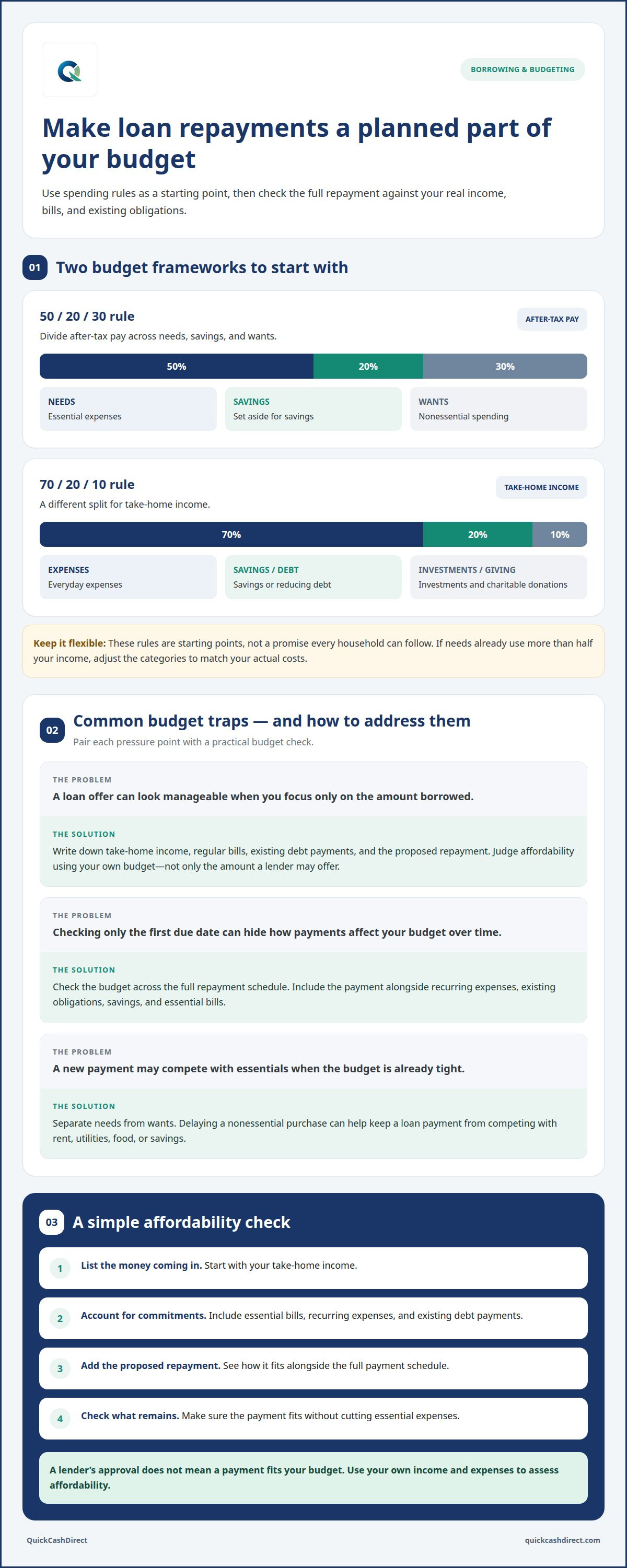
A popular budget rule can turn a loan payment from a surprise into a planned expense. The 50/20/30 rule allocates 50% of after-tax pay to needs, 20% to savings, and 30% to wants; the 70/20/10 rule assigns 70% of take-home income to expenses, 20% to savings or debt reduction, and 10% to investments and charitable donations. Financial literacy for borrowers means knowing which costs fit your budget and how credit history, interest, and payment habits affect borrowing.
It’s reasonable to want a simple way to decide what you can afford. Use these budget rules as starting points, then account for your regular bills and loan repayments. This guide explains how credit history can influence loan terms, how interest adds to what you repay, and how prompt payments and a realistic budget can help you manage borrowing. You’ll have a clearer framework for weighing a loan’s costs against your income before you commit.
Key Takeaways
- See how your credit history can influence loan eligibility and the interest rate offered.
- Build loan repayments into your budget so you can judge whether a payment fits your income and expenses.
- Look beyond the amount borrowed: the rate and repayment schedule shape the total interest you pay.
- Understand how paying bills on time can support your credit history and help you stay on track financially.
Credit history and loan interest rates
Credit history helps lenders assess how you’ve managed borrowing and bills. Understanding your credit record is one part of financial literacy for borrowers, along with comparing costs and planning repayments.
Creditworthiness and Repayment History
Creditworthiness is a lender’s assessment of how likely you are to repay borrowed money. Your repayment history can show whether you’ve paid bills and debts on time, missed payments, or left balances unpaid. Lenders may use these details to assess eligibility, set loan amounts, and determine interest rates. Before applying, review your income, regular expenses, existing debts, and payment history to judge what repayment fits your budget.
Credit Scores and Loan Eligibility
A credit score is a numerical summary of information in a credit file. In the United States, a credit score is a three-digit number ranging from 300 to 850, according to the Consumer Financial Protection Bureau. Lenders may use scores when deciding whether you qualify, what interest rate applies, or what credit limit you receive. Scores are one factor, not a complete picture of your finances. If you’re preparing to apply, gather accurate income and expense details and consider how a new payment fits alongside existing obligations.
Credit Ratings and Reports
A credit report records aspects of your credit history, such as identifying details, payment history, debts, loans, and bankruptcy filings. A credit score summarizes credit information, while the report provides the underlying details. Review your report for errors or unfamiliar accounts before seeking credit, since inaccuracies can affect how lenders view your history. The three nationwide credit bureaus provide consumers with a free credit report every year. For free financial counseling and loan education, look for nonprofit counseling organizations and public financial education programs that offer no-cost support.
Comparing Loan Costs and Terms
Compare loan offers by weighing the interest rate, APR, fees, repayment schedule, and total amount due together. APR expresses borrowing costs as a yearly rate and can help you compare offers, while the payment schedule shows when amounts are due. Read the agreement before accepting: a lower payment may come with a longer repayment period. Be cautious of pressure to act immediately, unclear costs, or promises that sound guaranteed, which can signal predatory lending or a scam. Choose only after you understand the terms and know the payments fit your expenses.
Budgeting and spending rules
A budget shows how a loan payment fits alongside everyday expenses. Start with take-home income, list essential bills, then account for savings and debt payments before deciding what remains for wants. This makes financial decisions more concrete than focusing only on the amount a lender may offer.
The 50/20/30 rule divides after-tax pay into three categories: 50% for needs, 20% for savings, and 30% for wants. Treat loan repayments as a planned obligation, then see whether they fit without cutting essential expenses. If needs already use more than half your income, adjust the categories to match your actual costs rather than forcing the rule.
Another framework is the 70/20/10 rule: 70% of take-home income goes to expenses, 20% to savings or reducing debt, and 10% to investments and charitable donations. Use one method as a starting point, not a promise that every household can follow the same split. A changing income or recurring expense may call for a different allocation.
Before borrowing, write down your income, recurring bills, existing debt payments, and the proposed repayment. Check the budget across the full repayment schedule, not just the first due date. Separate needs from wants, too. Delaying a nonessential purchase can keep a new payment from competing with rent, utilities, food, or savings.
U.S. borrower protections vary by loan type and the rules that apply. Before accepting an offer, read the written terms, including the payment schedule, interest rate, fees, and charges. A lender’s approval doesn’t mean the payment fits your budget, so assess affordability using your own income and expenses.
Students weighing higher education costs can include tuition-related expenses and any student loan payments in the same plan. Review account statements and reports for existing obligations, then consider how a new payment affects monthly cash flow. Financial education helps students compare that commitment with other priorities before deciding to borrow.
If a necessary expense exceeds available cash, compare the budget impact with short-term loan options before committing.
Calculating interest paid or earned
Interest is the cost of borrowing, usually expressed as a percentage of the amount borrowed over time. For a lender, interest is earnings on money lent. The calculation has two sides: borrowers track the added cost, while lenders track the return. Understanding the calculation helps you judge a loan by its repayment cost, not only by the amount received.
For a basic simple-interest estimate, multiply the principal by the annual interest rate and the time expressed in years. The result estimates interest before fees or other charges. If the term is less than a year, express that period as a fraction of a year. This formula is a starting point; the agreement determines how interest accrues and how payments affect the remaining balance.
With an installment loan, each payment may cover interest and reduce principal. As the principal falls, later interest charges may also fall if the agreement calculates interest on the outstanding balance. Paying off a loan faster reduces the amount paid in interest. Check the repayment schedule to see how payment timing and any charges affect the total, rather than assuming every loan uses the same method.
- Identify the principal: Find the amount borrowed or the balance used for the calculation.
- Read the rate: Note whether the agreement gives an annual rate and how it applies.
- Check the period: Match the rate to the time covered by the calculation.
- Review total repayment: Include fees and scheduled payments when assessing the full cost.
Credit card interest deserves close attention. The average interest rate on credit cards is above 20%. Carrying a balance can make purchases cost more over time, so examine the card agreement and payment terms. A rate alone doesn’t show the full borrowing cost; fees, balance changes, and repayment timing also matter. Consumer financial protection resources can support financial education, but use your loan documents to understand the specific calculation that applies.
Federal loan programs may have distinct terms, so identify the loan type before using an estimate. Compare the expected interest with the full repayment obligation. These steps turn a rate into a practical measure of what borrowing may cost.
Paying bills promptly
Making a payment by its due date can help maintain a positive repayment history. That record may affect your credit history and a lender’s assessment of future applications. Use a calendar reminder or scheduled payment to build a consistent routine. Keep enough money in the account and confirm that the payment cleared.
Organize bills by due date and priority. For example, add the loan payment, housing costs, utilities, and other regular obligations to one calendar. Review it when income arrives, then set aside the amounts due before discretionary spending. This simple system helps protect your ability to meet obligations without relying on memory or last-minute transfers.
If you can’t make a loan payment, contact the lender as soon as possible and explain the situation. Ask about options, such as changing the repayment arrangement or restructuring the loan. Discussing the problem early can help you understand the consequences and possible next steps before missing a payment.
- Track due dates: Record each bill’s date and required payment in one calendar.
- Set reminders: Schedule an alert before each due date, allowing time to address account issues.
- Check transactions: Confirm payments post and keep records of confirmations or lender communications.
- Review your budget: Adjust planned spending when an upcoming bill competes with essential expenses.
Late payments may lead to penalties and can harm your credit history. If a payment is already overdue, check the loan agreement for the amount due and contact the lender to discuss a way forward. The Consumer Financial Protection Bureau provides consumer information about managing money and borrowing. Don’t assume an extra payment or changed date automatically updates your repayment schedule; ask for the terms to be explained clearly.
Protect room in your budget for essentials before considering new borrowing. If a necessary expense still requires financing, review available loan options and assess whether the repayment fits your income.
QuickCashDirect
QuickCashDirect provides access to short-term financial options when an unexpected expense leaves a gap in your budget. Its offerings include Payday Loans, Cash Advance, Payday Loans Online, and Loans for bad credit. Use what you’ve learned about repayment planning to assess whether borrowing fits your income and upcoming bills. Before choosing any loan, review its interest rate, fees, repayment schedule, and total amount due. Borrow only when the payment plan works alongside essential expenses and existing obligations. These options are designed for borrowing needs, not for improving a credit report or replacing a long-term financial plan. If you’re considering a loan, contact QuickCashDirect to discuss your borrowing needs.
Make Your Next Borrowing Decision Deliberate
Build financial literacy for borrowers into your regular money routine, not just the moment you need credit. Before taking on a new obligation, ask whether it supports a necessary goal, fits your wider financial priorities, and leaves room for unexpected expenses. This brief review can help you choose with greater control instead of reacting under pressure.
Keep a personal borrowing record with the agreement, payment dates, and notes about what worked. Over time, it can help you recognize which commitments fit your circumstances and make future financial decisions with more confidence. Borrowing should serve a clear purpose, not become the default response to every shortfall.
If you have questions as you consider your next step, contact QuickCashDirect with questions. Take the time to understand your options, make a considered choice, and move forward with a plan you can manage.
Frequently Asked Questions
What Are Some Popular Personal Budget Rules?
Two common approaches are the 50/20/30 rule and the 70/20/10 rule. The first assigns 50% of after-tax pay to needs, 20% to savings, and 30% to wants. The second directs 70% of take-home income to expenses, 20% to savings or debt reduction, and 10% to investments and charitable donations. Treat either as a guide, then adapt it to your actual obligations.
What is Credit?
Credit lets you borrow money from a lender and repay it over time. It can help cover a purchase before you have the full amount available, but repayment terms determine what you owe and when. Before using credit for a necessary expense, consider whether each scheduled payment fits alongside your existing bills and other financial commitments.
Why Is Financial Literacy Important?
Financial literacy helps you make informed choices about borrowing, spending, saving, and investing. For borrowers, it means understanding the commitment before accepting funds, rather than focusing only on immediate access to money. Strong financial literacy skills can help you see how a new obligation affects other goals, prepare for due dates, and avoid taking on payments that strain your finances.
What credit score do I need to qualify for common loans in the United States?
There isn’t one credit score that guarantees qualification for every common loan in the United States. Lenders set their own eligibility criteria and may consider your score alongside income, existing debt, and repayment history. A score can influence an application, but it doesn’t determine every outcome. Check the lender’s stated criteria and assess affordability before applying.
How do credit reports and credit scores affect borrowing costs?
Lenders may use information in your credit report and your credit score to assess eligibility and set loan terms, including the interest rate. For example, an unfamiliar account or incorrect payment detail could affect how your history appears. Review your records before applying, and dispute inaccurate information through the relevant credit bureau so your file reflects your history.
How do I calculate monthly loan payments and total borrowing costs?
For a fixed-rate installment loan, use the principal, monthly interest rate, and number of monthly payments to calculate the scheduled payment. Multiply that payment by the number of payments to estimate the total repaid, then subtract the principal to estimate interest. Add applicable fees separately. Compare the result with the agreement, since payment timing and loan terms affect the calculation.