
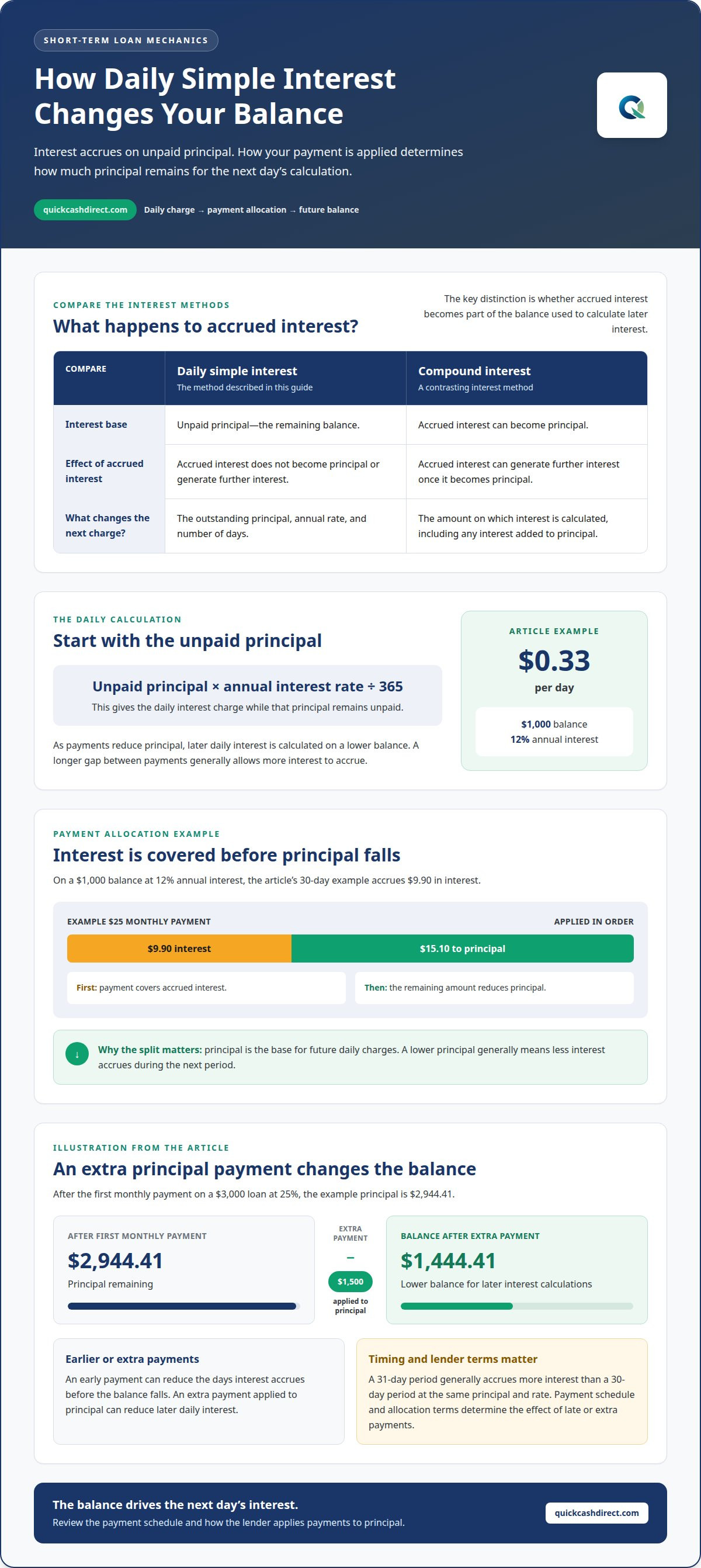
The amount borrowed is only part of a short-term loan’s cost. The daily interest calculation on short term loans multiplies the unpaid principal by the annual interest rate, then divides by 365. For example, at 12% annual interest, a $1,000 balance accrues about $0.33 in interest per day.
A daily charge may look small, but it adds up while principal remains unpaid. The amount borrowed, the interest rate, the time between payments, and how much each payment reduces principal all affect the total interest.
This guide explains how daily simple interest accrues, how payments are applied, and how the loan amount, rate, and term shape the cost of a short-term personal loan. Understanding the calculation can help you see what drives repayment before deciding whether borrowing fits your needs.
Key Takeaways
- See how payments cover accrued interest before reducing principal, and why extra or early payments can change what you owe over time.
- Understand how the amount borrowed, annual rate, and repayment term shape total interest and payment size.
- Learn why interest keeps accruing on unpaid principal and how the timing of payments affects the balance.
- Use the loan terms and repayment schedule to assess whether a short-term personal loan fits your needs before borrowing.
What is a daily simple interest loan?
A daily simple-interest loan charges interest each day on unpaid principal. Unlike compound interest, accrued interest does not become principal and generate further interest. For borrowers, the daily interest calculation on short-term loans shows how the balance and time affect repayment.
Payment allocation between interest and principal
Each monthly payment generally covers accrued interest first, and the remaining amount reduces principal. In a $1,000 example at 12% annual interest, daily interest is about $0.33. Over 30 days, that totals $9.90. From a $25 monthly payment, $15.10 goes to principal. This split matters because the principal determines the base for future daily charges. A lower balance generally means less interest accrues during the next period.
Effects of early and extra payments
An early payment can reduce the days interest accrues before the payment lowers the balance. An extra payment applied to principal cuts the balance further, which can reduce future daily interest and repayment time if scheduled payments continue. For example, after the first monthly payment on a $3,000 loan at 25%, the principal is $2,944.41. An extra $1,500 payment brings it to $1,444.41, reducing the balance on which later interest accrues.
Late or missed payments leave principal unpaid for longer, so daily interest continues to accrue. The lender’s payment schedule and allocation terms determine how a late or extra payment affects the balance.
Timing changes the total: a 31-day period generally accrues more interest than a 30-day period at the same principal and rate. Making payments on or before their monthly due date can keep interest closer to the original repayment plan. Before paying extra, determine how the lender applies it, since the principal reduction is what lowers future daily interest.
Loan principal, interest, and term inputs
A useful estimate starts with the principal, interest rate, and loan term. Principal is the amount borrowed; the interest rate sets the borrowing cost, and the term determines how long repayment lasts. Together, these inputs shape the total amount repaid. A loan calculator can show how changing one input affects the estimate.
State rules for short-term loan interest rates and fees vary by state and loan type. No single rate limit applies to every short-term loan across the United States.
Fees and origination charges can add to borrowing costs or affect the amount you receive, depending on how the lender applies them. APR includes interest and fees, so it can help reveal costs beyond the stated interest rate. Include applicable charges when reviewing the total amount due.
Compare rates using the same principal and loan term. This makes it easier to see how a rate difference can add up over a longer repayment period. Credit may also affect the rate offered, so compare the actual terms presented to you.
A short-term business loan calculator can organize principal, rate, term, and charges into an estimate. Use consistent inputs when comparing scenarios, then review both the periodic payment and total repayment. A shorter term can mean larger payments, while a longer term can mean more interest overall.
Paying off a loan early may reduce future interest by lowering the balance sooner. Potential savings depend on the remaining principal, interest rate, time left, and how the lender applies payments. Model an earlier payoff with a calculator, then compare its estimated total cost with the scheduled repayment plan. Actual short-term loan calculations depend on the lender’s terms.
How daily simple interest accrues on unpaid principal
Daily simple interest is based on outstanding principal, not just the original amount borrowed. The daily charge changes when the balance or annual rate changes.
Accrual on unpaid principal
This method calculates daily interest by multiplying unpaid principal by the annual rate, then dividing by 365. Interest accrues each day on the remaining balance. That larger illustration shows why principal matters: the daily amount is tied directly to the balance. Payments can affect the balance used to calculate later interest.
Reducing interest through faster principal payments
Paying down principal faster reduces the balance used to calculate interest on subsequent days. This can lower total interest over the repayment period, especially when additional payments are applied to principal. The effect depends on when the lender posts a payment and how the loan terms treat it. Compare the scheduled repayment with a faster principal reduction to see how the balance changes, rather than assuming every extra payment automatically shortens the term.
Daily interest at different APRs
When the principal and calculation method are unchanged, daily interest rises with the annual rate. A lower APR on the same balance means a smaller daily charge; a higher APR means a larger one. Compare APRs using the same principal and number of days to understand their effect on daily and total interest.
Accrual start and payoff calculation
Interest accrues daily while principal remains unpaid. A payoff amount therefore includes outstanding principal, interest accrued through the payoff date, and any applicable charges under the loan terms. The exact amount can change from day to day as interest accrues. For an estimate, identify the balance, annual rate, elapsed days, and payment timing used in the calculation. The lender’s terms determine how these inputs affect the final payoff.
Interest on short-term personal loans
For a short-term personal loan, the key is how the interest method works with the repayment schedule. With daily simple interest, charges accrue on unpaid principal, so the amount applied to principal affects later interest. A monthly payment may cover accrued interest and reduce principal, with the split changing as the balance changes. Review the schedule, not just the initial payment.
Consider the illustrative 36-month loan of $3,000 at 25% annual interest. Those figures describe that example, not every personal loan. The takeaway is to compare the payment and total repayment together. A manageable monthly payment alone doesn’t show the full amount borrowed back over the term.
Payment timing matters because interest continues to accrue on unpaid principal between payments. A late or missed payment can leave a higher balance outstanding for longer, while an on-time payment reduces principal after accrued interest is covered. When reviewing a personal loan, note the due dates, payment amount, and how payments are applied. Consider whether the schedule fits the income available during each repayment period.
A credit score reflects factors such as payment history, types of credit, and debt-to-income ratio. It does not change the daily-interest formula, but it forms part of a borrower’s credit profile. Before borrowing, use the loan’s stated principal, rate, term, payment schedule, and charges to assess the total repayment. Short-term loan calculations are estimates, so review the exact payment terms before taking out a loan.
QuickCashDirect
QuickCashDirect connects borrowers exploring short-term financing with options such as payday loans, cash advances, online payday loans, and loans for bad credit. The service is free and introduces applicants to lenders; it is not a lender, and approval is not guaranteed. Use the interest concepts above to understand how principal, annual rate, payment timing, and loan term can affect repayment. Before accepting an offer, review its payment schedule and total repayment to assess whether the terms fit your budget. A loan may not suit every situation, especially if scheduled payments would strain your finances. Explore your options through QuickCashDirect and consider how repayment fits alongside your other obligations.
Choose your next step with confidence
Make a decision based on your budget, not just an urgent need. The daily interest calculation on short-term loans can help you understand how borrowing costs respond to principal, rate, and payment timing. The right choice also depends on whether the repayment schedule leaves room for essential expenses and other commitments.
Before proceeding, consider what the funds need to cover, when repayment is due, and how you will manage the payment alongside your regular obligations. If repayment would create pressure elsewhere, pause and reconsider. If borrowing still fits, review the available options and the terms that would apply to your situation.
Contact QuickCashDirect to discuss your options. Take the next step with a clear view of what repayment means for you.
Frequently Asked Questions
How is daily interest calculated on a short-term loan?
Multiply unpaid principal by the annual interest rate, then divide by the year’s day-count basis to find the daily charge. Multiply that figure by the number of days until the next payment or payoff. For example, if a payment posts later than planned, interest accrues for those extra days on the principal still outstanding. The agreement’s calculation method and payment-posting rules determine the exact result.
What is the daily interest formula using APR and loan principal?
For a simple estimate, use: unpaid principal × annual rate ÷ 365 = daily interest. Convert the APR percentage to a decimal before multiplying, such as writing the rate as a fraction of one. Then multiply daily interest by the accrual days. APR can include fees as well as interest, so this formula is an estimate of interest, not necessarily every amount included in the loan’s total cost.
Is daily loan interest calculated using a 360-day or 365-day year?
The calculation example in this guide uses a 365-day year. The day-count basis can affect the daily charge, so use the method specified in the loan agreement rather than assuming every lender uses the same basis. Check which dates count toward accrued interest and when payments are credited. Those details help explain why an estimate may differ from a lender’s payoff figure.
How do lenders calculate interest on a declining loan balance?
With a declining-balance method, interest is calculated on the principal remaining after payments are applied. Each payment first covers amounts due under the agreement, including accrued interest; the rest reduces principal. The next interest calculation uses this lower balance. To understand a statement, compare the opening balance, payment date, amount credited to principal, and closing balance for each repayment period.
What are typical APRs and fees for payday, personal, and title loans in the United States?
There is no single typical APR or fee for payday, personal, and title loans across the United States. Costs can depend on loan type, state rules, lender terms, repayment period, and charges. Review the APR, itemized fees, payment schedule, and total repayment in the agreement. For a short-term loan, repayment amounts and due dates are essential to assessing affordability.